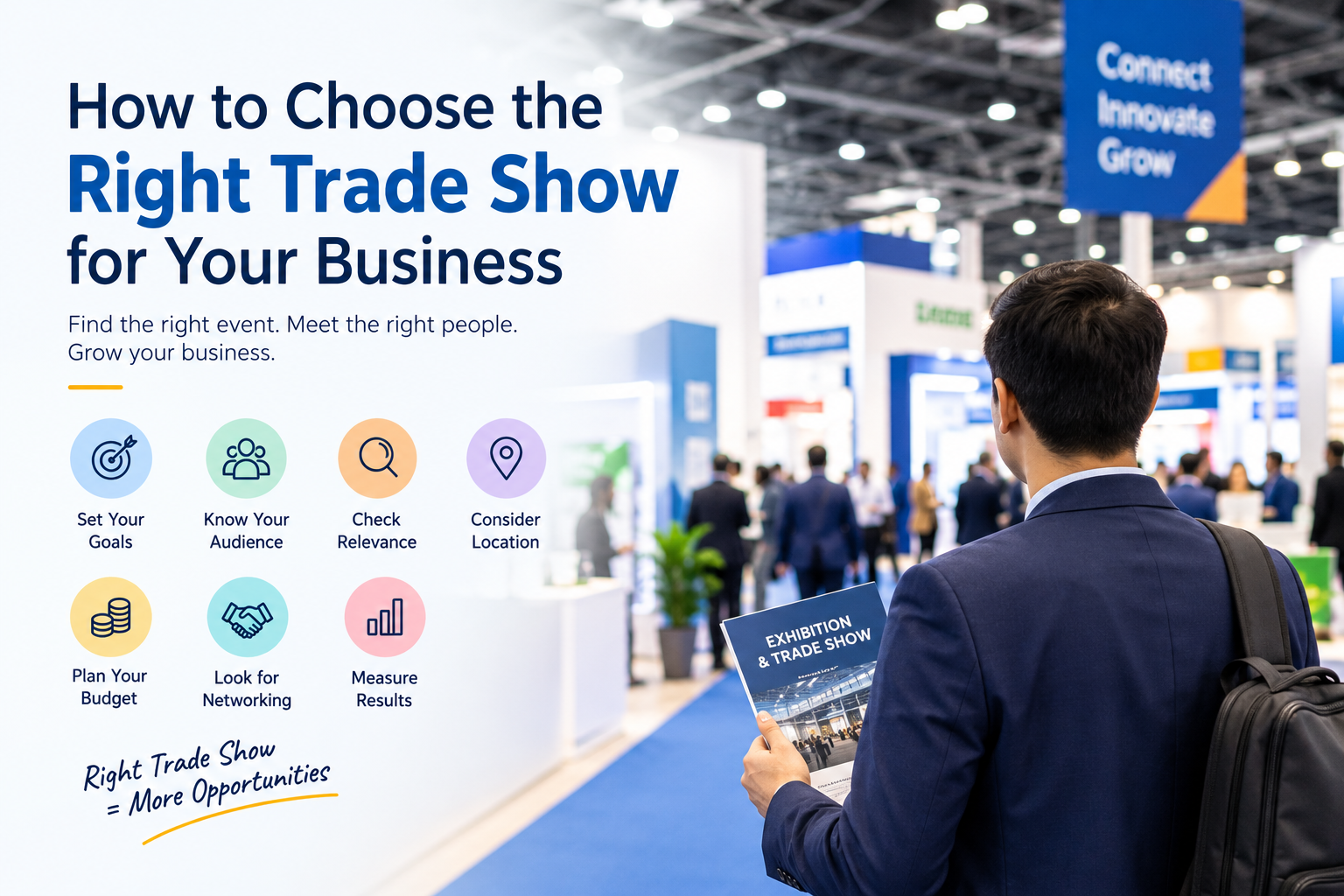
Choosing the right trade show can help your business reach new customers, meet industry professionals, build partnerships, and generate quality leads. However, not every trade show is suitable for every business.
With thousands of exhibitions and trade shows taking place every year, it is important to choose an event that matches your business goals, target audience, industry, and budget.
In this guide, we will explain how to choose the right trade show for your business in simple steps.
Before selecting an exhibition, first decide what you want to achieve.
Your goal could be:
Having clear goals makes it easier to compare different trade shows and select the most useful one for your business.
The right trade show should attract the people you want to reach.
For example, if you sell industrial equipment, an exhibition focused on manufacturing, engineering, or industrial technology may be more valuable than a general business event.
Before registering, check:
A trade show with fewer visitors but the right audience can often be more valuable than a large event with the wrong audience.
Choose an exhibition that is closely connected to your industry and products.
Look at the event’s previous editions and review the exhibitors, sponsors, speakers, and visitor profiles.
You can also check whether your competitors are participating. If established companies in your industry regularly attend the event, it may indicate that the exhibition has strong industry relevance.
However, competitor presence should not be your only reason for participating. Your main focus should remain your target customers and business goals.
Before booking your exhibition space, research previous editions of the trade show.
Look for information such as:
If possible, ask the organizer for an official post-event report. This can give you a better idea of the event’s reach and audience quality.
Location can have a major impact on your trade show results.
A local exhibition may be ideal if you mainly serve customers in one city or region. On the other hand, an international trade show may be better if you want to expand into new markets.
Consider:
The best trade show is not always the biggest one. It is the one that brings your business closer to the right customers.
Your trade show budget should include more than the custom exhibition booth cost.
Consider the complete cost, including:
Calculate the expected return before making a final decision.
A smaller exhibition with a highly relevant audience may deliver better ROI than an expensive international event.
Trade shows are not only about displaying products. They are also valuable networking platforms.
Check whether the event offers:
These activities can help your team build relationships with potential customers, partners, distributors, and industry professionals.
The exhibitor and visitor profile can tell you a lot about the quality of a trade show.
Try to understand:
Visitors: Who attends the event and what are their job roles?
Exhibitors: What companies participate and what products do they offer?
Decision-makers: Are business owners, managers, buyers, procurement teams, or other decision-makers attending?
The closer the visitor profile is to your ideal customer, the greater the potential value of the exhibition.
Once you select the right trade show, start preparing early.
Create a plan for:
Do not wait until the event starts to find customers. Contact potential visitors and existing customers before the exhibition and invite them to meet your team at your booth.
After the event, measure your results against your original goals.
Important trade show KPIs can include:
This information will help you decide whether you should participate in the same trade show again.
Choosing the right trade show is an important business decision. The biggest exhibition is not necessarily the best exhibition for your company.
Start by understanding your goals, target audience, industry, budget, location, and expected ROI. Research previous editions and compare the visitor and exhibitor profiles before making your decision.
With the right trade show strategy, your business can use exhibitions to generate quality leads, build strong relationships, increase brand visibility, and create new business opportunities.
If you are looking for the right exhibition or trade show for your industry, explore upcoming events and find an event that matches your business objectives.
